
We have all heard of Table Mountain in Cape Town, South Africa - Many remarking that this is one of the natural wonders of the world. Incredible though this is, let us look to the lesser known but equally impressive 'alternative' table top mountains around the world......
11. Preikestolen, Norway
OK, so this is not actually a mountain, instead a steep flat cliff which we are sure you would agree is incredible. At 604 m (1982 ft) high, those who dare to peer down from the edge find themselves on top of the world. With no fences or rails the views of Lysefjorden and its surroundings are unspoiled and authentic. Interestingly the cliff drops into a mild climate zone so you can visit this all year round.
How to get there?
Preikestolen is roughly an hour from Stavanger by ferry or car. WHen you arrive, there is still a 2.4 mile trail to the top.
Preikestolen is roughly an hour from Stavanger by ferry or car. WHen you arrive, there is still a 2.4 mile trail to the top.
Travel Hotspot will help you arrange your itinerary.
01284 619100


10. Brown Bluff - Antactic
Nestled on the shoreline occupied by thousands of Adelie and Gentoo penguins who call this home is Brown Bluff, an ice capped flat top mountain reaching 745 meters (2,444 ft) high. It is a Tuya, a unique volcano with a prominent cliff of reddish-brown rock. Guided tours and expeditions to the area enable you to explore the mountain and abundant wildlife, flora and fauna in the area.
How to get there?
Travel Hotspot sources many adventure cruises touring Antarctica.
01284 619100


9. Mount Conner - Australia
Located in the Northern Territory Mount Conner is a flat-topped, horseshoe shaped mountain close by (in Australian terms) to Uluru and Kata Tjuta. The Aboriginal Australians in the area refer to Mount Conner as Artilla and believe the mountain was once inhabited by icemen who create cold weather.
How to get there?
Take a highlights tour of the Northern Territory, where you will also visit the more famous Uluru and Kata Tjuta. Or just fly in to Alice Springs and take a car from there.
Take a highlights tour of the Northern Territory, where you will also visit the more famous Uluru and Kata Tjuta. Or just fly in to Alice Springs and take a car from there.
Ask Travel Hotspot on the best ways to get around.
01284 619100


8. Debre Damo - Ethiopia
Debre Damo is an isolated table-topped mountain in northern Ethipia. Home to a 6th Century monastery at its flat peak, among other religious buildings - the only access to the top is by rope up a sheer cliff. The monastery has a unique collection of ancient manuscripts and is the earliest existing church building in Ethiopia and little has changed of the building in that time. One drawback to this fascinating place is that the church is only accessible to men, sorry ladies!
The views are pretty incredible too!
How to get there?
Ask Travel Hotspot for details
01284 619100


7. Mount Asgard - Canada
Deep in the Auyuittuq National Park Baffin Island standing at 2015 m (6610 ft) are the imperious twin peaks of Mount Asgard, the most famous of the Baffin Mountains. Know as Sivanitirutinguak by the Inuits, Mount Asgard got its name from Scandinavian mythology where Asgard is the realm of the Norse Gods.
Perhaps most famous for being the real location for a Base jump sequence at the start of the 1976 James Bond film The Spy Who Loved Me - the fictional setting was the Austrian Alps.
Auyuittuq National Park has an abundance of unspoiled nature, high peaks and enigmatic serenity.
How to get there?
It is certainly not the easiest of places to visit with very few tourist facilities, indeed only one campsite throughout this huge reserve on Baffin Island's Cumberland Peninsula. 10 - 16 day tours are available year-long from Pangnirtung or Iqaluit.
Speak to Travel Hotspot for more information
01284 619100


6. Kukenan - Venezuela
Kukenan is the lesser known of the 3 table mountains (called Tepui in the local dialect) of Venezuela on this list, however equally impressive boasting the second tallest waterfall in the world as a resident. The Angel Falls are the tallest and located nearby. Kenenan Falls stands at 674 m (2,211 ft) high at the southern part of the 2,680 m (8,790 ft) tall mountain, and is certainly a beautiful sight to behold.
It is harder to climb than its more famous sibling Mount Roraima so ascended much less mean more satisfaction if you do manage!
How to get there?
A trail from San Francisco de Yurani will lead you to Kukenan. Get there by bus from Caracas, Ciudad Bolivar or Ciudad Guyana. You can also hire a vehicle from San Fransisco.
Speak to Travel Hotspot for more information
01284 619100


5. Heroubreio - Iceland
Despite centuries of knowledge of the existence of the sixth largest Icelandic peak Heroubreio, due to the mountain's steep and unstable side the first ascent wasn't until 1908. Situated in the Highlands of Iceland the mountain is a flat-topped, steep sided volcano. The mountain type is known as a tuya, forming after lava erupts though a thick glacier.
How to get there?
Heroubreio mountain is next to Blafjall and is located in the northeast of Iceland.
Travel Hotspot offer many different types of trips to Iceland.
01284 619100

4. Canyonlands - Utah, USA
The National Park of Canyonlands in Utah offer a colourful landscape of eroded canyons, gorges and mesas all divided by the Colorado and Green Rivers. You will find Canyonlands has a variety of table-top mountains with amazing views across the surrounding area.
This is a popular destination for hundreds of thousands of tourists each year, with exciting activities on offer including hiking, kayaking and mountain biking - not forgetting those stunning views, something typical of Utah.
How to get there?
Ask Travel Hotspot for flight details to Canyonlands Field Airport from Denver.
01284 619100


3. Auyantepui - Venezuela
The most visited of the 'tepui' of Venezuela, Auyantepui meaning 'Devil's Mountain' (in the native language of the Pemon people) is home to the highest waterfall in the world, Angel Falls. At 979 m (3,212 ft) high Angel Falls is a site to behold, but it is not the only treasure to be found at Auyantepui - its unique plateau is heart shaped and the mountain spanning an area of 666.9 square kilometers hides a vast cave system.
The Angel Falls water plunges from Auyantepui and is argued to be one of the most spectacular places on Earth. The falls get their name from the pilot Jimmie Angel who discovered them in 1933 purely by coincidence. On an ill-fated return trip in 1937, Jimmie crashed his plane on top of the mountain. Luckily Jimmie and his small crew survived however it too them 11 days to descend the mountain.
How to get there?
You can reach the falls by taking a boat trip from Canaima. Alternatively fly to Kamarata and then continue the journey on foot.
Call Travel Hotspot for more information
01284 619100


2. Mount Roraima - Venezuela
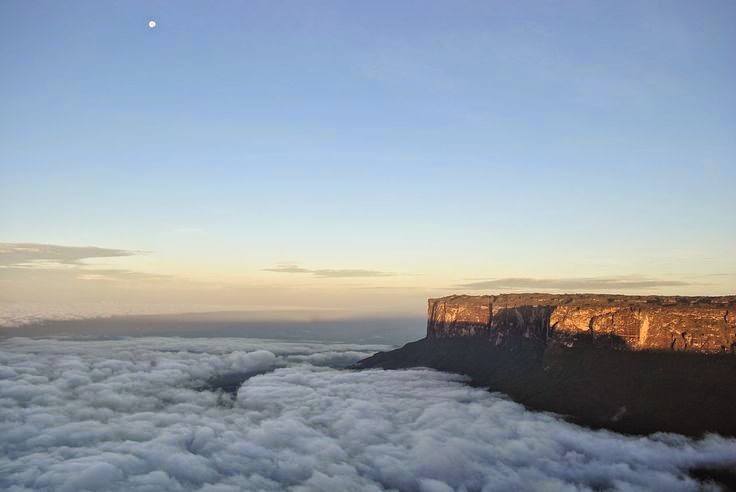
Mount Roraima is not only the highest mountain in the Pakaraima range at 2,772 m (9094 ft) but also the most famous tepui in Venezuela and spans over the 3 borders of Venezuela, Guyana and Brazil.
Located on a 2 billion year old plateau like the other tepui mentioned it is deep in the jungle, forming an island of rock that pierces the jungle canopy. Considered to have some of the oldest geological formations on Earth Mount Roraima is culturally, historically and geologically extremely important, and the surroundings also feature a variety of unique plants. As the table tip is complete isolated from the ground, these "islands in the forest" offer a huge array of unique species of plants and animals not found anywhere else in the world.
Mount Roraima was made famous by the fictional novel The Lost World written by Sir Arthur Conan Doyle in 1912 which feature a Roraima-like mountain. In the pages of the book an expedition goes in search of prehistoric plants and dinosaurs which were believed to be native to the flat mountain top and unchanged for millions of years. It also featured as the magical land in the Pixar film "UP".
How to get there?
Hikers start the journey from Paraitepui. A round trip to the summit and back will take you six days.
Call Travel Hotspot for more information
01284 619100


1. Table Mountain - Cape Town, South Africa
Overlooking the city of Cape Town is the most famous of table top mountains, aptly named - Table Mountain. The plateau is roughly 3 kilometers from side to side and surrounded by steep cliffs. One of the most popular attractions in South Africa, at 1,086 m (3,563 ft) the trip to the top is worth it for the stunning panoramic views of the landscape, city and sea. As well as hiking you can also go climbing, mountain biking and access the unusual cave system formed from sandstone, and plenty more.
The mountain gets its name from Antonio de Saldanha who was the first European to land in Table Bay in 1503. After climbing it he named it 'Table Mountain'.
How to get there?
The peak is easy to get to with tourists either taking the cable car or hiking.
Travel Hotspot offers many travel options to Cape Town and the rest of South Africa
01284 619100


We at Travel Hotspot are just as keen to travel as you, some of these are certainly in our travel plans.
We love to help people find that special new adventure.
01284 619100


